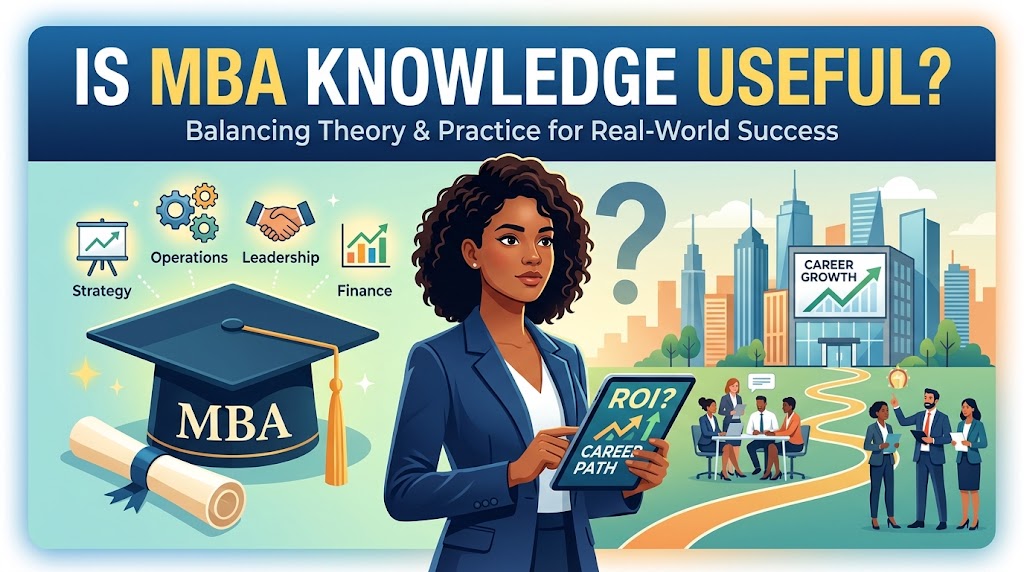


Many people believe that an MBA is a ticket to success. Others say that it is only a collection of theories that do not work in the real world. After completing my own MBA program, I think the truth lies somewhere in the middle.
MBA knowledge can be very useful, but it can also become useless if it is not used in the right way. In my opinion, there are three important points that can increase its value.
First, we should continue learning even after graduation. The subjects taught in an MBA program are mostly fundamental. They cover strategy, finance, marketing, economics, leadership, and many other fields. Because the range is so wide, students sometimes finish the program with only a basic understanding of each topic. In addition, knowledge can easily be forgotten or become outdated as the business world changes. Therefore, graduates should not simply try to remember what they learned. Instead, they should use the MBA as a strong foundation and continue learning, especially in their own area of expertise and related fields.
Second, we should recognize that MBA knowledge is not always useful. This may sound strange, but every theory and framework is only a tool. Like any tool, it works well in some situations but poorly in others. Sometimes using a framework may even lead to the wrong decision because every company has different goals, cultures, and challenges. Good managers understand not only how to use a tool but also when not to use it. Knowing the limits of a theory is just as important as knowing its strengths.
Third, we should create an environment where MBA knowledge can be applied, or choose to work in such an environment. Some organizations rarely encourage strategic thinking or data-based decision making. In such places, MBA knowledge may remain unused. People then have two choices: forget what they learned or find ways to introduce new ideas and better management practices. If that is impossible, they may need to move to an organization where their knowledge can make a real difference.
This idea also explains why “best practices” should be treated carefully. Many business books introduce successful companies and suggest that copying them will bring the same results. However, if one method truly guaranteed success, every company would already be using it. It would no longer create a competitive advantage. Every business has different customers, employees, resources, and markets. A strategy that succeeds in one company may completely fail in another.
Instead of blindly following famous examples, managers should observe their own situation carefully, think from different viewpoints, and respect opinions that differ from their own. After making a decision, they should carry it out patiently, while accepting that every choice has both advantages and disadvantages.
After studying for my MBA, I realized that it was very different from the popular image many people have. Some textbooks and research papers are difficult to read, and some topics seem to have little practical value at first. However, academic theories are created by experts who spend many years studying a single field. They not only explain why a theory works but also discuss its limitations. This teaches students to think critically instead of accepting simple answers.
In contrast, many books written by business practitioners, especially those based only on personal experience, often make overly confident claims. Some of these books simplify things too much to appeal to readers, offering their own unsubstantiated ideas as the only right answer with total confidence.They may be interesting, but they should be read with caution.
An MBA does not provide magic answers. Instead, it develops the ability to judge what is reliable, what is doubtful, and what fits a particular situation. That ability may be the greatest value of an MBA.

コメント