

I recently started reading a textbook on behavioral economics. The first two chapters teach the basic ideas and methods of this topic in a clear way.
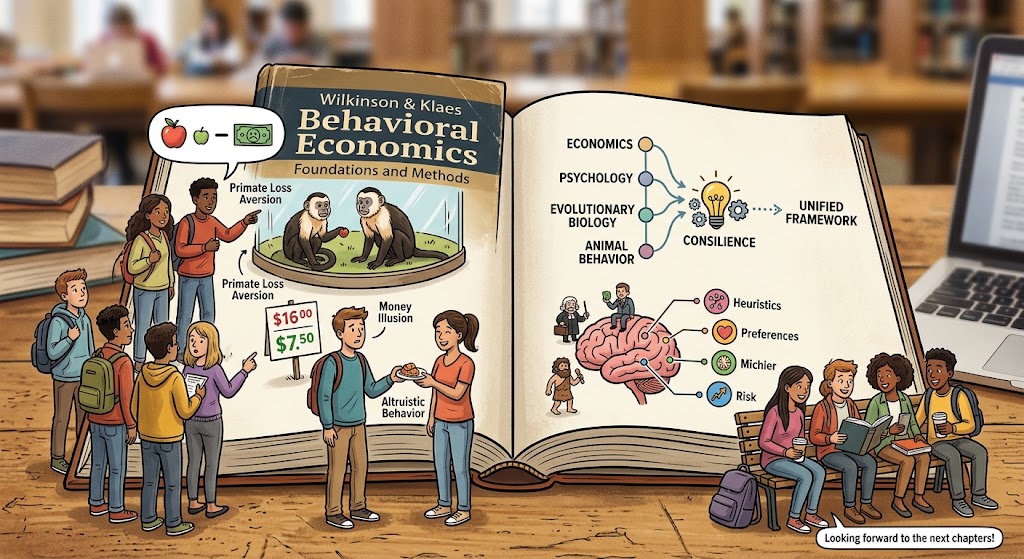
First, the book compares behavioral economics with traditional economics. It explains its history and how researchers study human choices. What is interesting is that it uses real-life examples from animals, such as monkeys. For example, it talks about how animals also dislike losing things, misunderstand money, and help others.
By looking at these behaviors across different species, the book addresses a common criticism of behavioral economics: that it merely provides ad-hoc explanations for individual anomalies without offering a unified theory. Positioning human psychological biases within evolutionary history suggests that these behaviors are not random errors, but deeply rooted evolutionary traits.
In Chapter 2, the authors talk about the idea of ‘consilience.’ This word means bringing together ideas from different subjects, like psychology and biology, into one big picture. By using this idea early in the book, the authors show that behavioral economics is a true scientific subject, not just a random list of facts.
The authors spent two full chapters on these ideas to give readers a strong foundation before moving on to specific topics like decision-making and risk. Even though this book is for university students, it has very deep and interesting ideas. I am excited to read the rest of the book!




コメント